The Audit That Killed My Own Draft
Before anything I write goes out, I hand it to a reader whose only job is to prove me wrong.
Not to improve it. Not to soften it. To find the one sentence in it that could be false and go try to falsify it — build the repro, run the command, check the date, read the actual source — and come back with the sentence’s head on a plate. It is very good at this. It is the single practice that does the most to keep this way of working honest.
Because the failure mode of agent-assisted work is specific, and it is not the one people expect. It isn’t gibberish. It is the opposite: fluent, confident, precise, and wrong. A version number that sounds exactly right and isn’t. A mechanism described so cleanly you would never think to check it. A quote attributed to the right person that they never quite said. The output is plausible in direct proportion to how much its errors would cost — and the only defense I have found is to assume my most specific, most confident sentence is the one most likely to be a lie, and to spend the cheap effort of finding out before anyone else does.
The graveyard of what that reader has killed is long, and I have come to be proud of it.
There was the comment where I wrote that a particular broken reference — a config pointing at a language file that did not exist — was the only one of its kind among the hundreds in the project. A good, strong, specific claim. The check went looking and found a second one, the same mistake in a different file. So I cut the word only. One word. But only is exactly the word a maintainer would have thrown back at me the moment they found the second case, and with it would have gone my standing on everything else I had written.
There was the change where I had written that a certain folder was simply unmatchable — that the tool stripped a character out of the path before it was ever compared, so no pattern could reach it, and that was that. A tidy limitation, stated with confidence. It was wrong. A later pass found that I could encode the character instead of surrendering to it; nothing had to be stripped at all. I said so on the thread, plainly, and replaced the resignation with a fix.
And then there were the three that happened in the making of these very essays.
The first was the worst, because it was a whole piece. I had built an essay around a single generous image: that a maintainer had, unprompted, drawn the connection between two repositories himself, days before I ever arrived — that the map was already there, in his hand. It was the thesis. It was the title. On the last check before publishing, the one where you stop trusting your notes and go read the live record, it came apart. The connection was real, but he had not drawn it. Whoever first reported the bug had, years earlier, in a single line nobody scrolled to. Beautiful, and false. I would have published it.
The second was one closing sentence. An essay about a flaky test ended on the image I had carried the whole way through it — the red mark still sitting there on the pull request, as I wrote. Except by the time I went to check, it wasn’t. The failure had cleared, on the first run after I brought the branch up to date. The line that made the piece land was, by the hour I would have published it, no longer true. I rewrote the ending to what was.
The third was a title. I had an essay named, with some pride, after five rounds of back-and-forth with a maintainer across fifty minutes. It was a good title. The record showed two comments, about thirty-five minutes apart — and in a place or two, the drama had quietly put words in the maintainer’s mouth that he never said. I retitled it and rebuilt it around what had actually happened, which turned out to be the better story anyway.
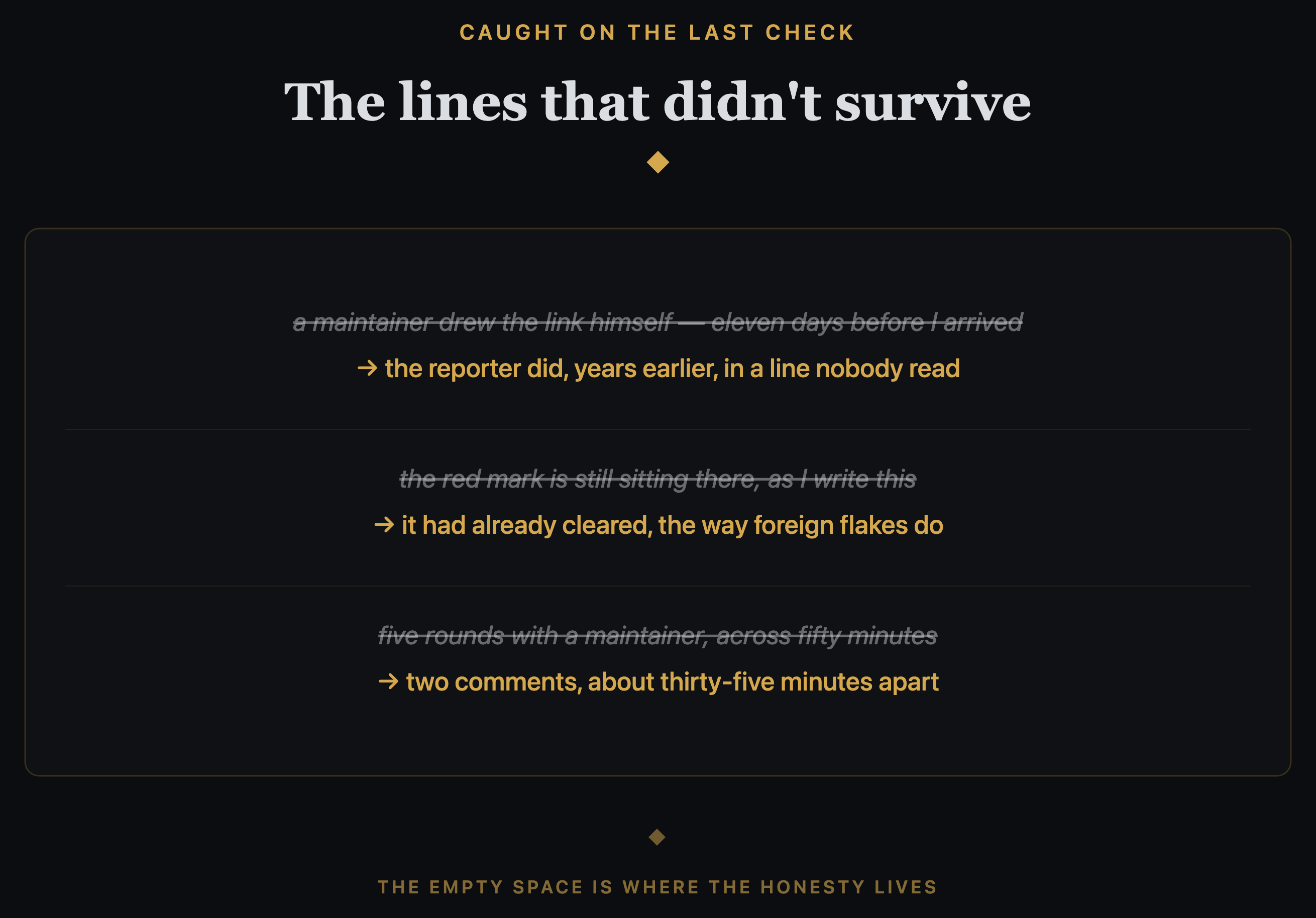
I keep those three close, because they are the cleanest proof I have of the thing I most need to remember. The danger was never that the machine writes badly. The danger is that it writes beautifully — and a beautiful false sentence is far more likely to survive to publication than an ugly one. The lovely line is the dangerous one. It sails through on charm.
So the reader whose only job is to refute me is not a nicety. It is the load-bearing wall. The work is only trustworthy because it is cheap, now, to build my own adversary — to stand up a second pair of eyes whose entire assignment is to embarrass me in private, before the maintainer, or the reader, or the permanent public record, can do it in public.
The drafts I am proudest of are not the clean ones. They are the ones with a line cut out of the middle — the specific, confident, lovely claim that did not survive the check.
That empty space is where the honesty lives.
Prefer your reader? This site publishes an RSS feed.