Marketing as a compiler target
I’ve been watching which writers Claude quotes when I ask it marketing questions. Not paraphrases — quotes. A specific sentence, lifted verbatim, dropped into the middle of an answer about pricing, or positioning, or onboarding flow. Click the source and you often find a blog post that’s a year or two old with a reader count in the low hundreds. Someone wrote a sentence well enough, once, that the synthesizer now returns it on demand to anyone asking the right question.
The old marketing math said a few hundred pageviews was a disappointment. The new math says the writer who landed that sentence right is doing compiler-target work for the next decade of AI answers — from a page the old crawler outpaced.
The crawler has changed
For twenty years, marketing content has been written for Google’s crawler. The optimizations were stable and well-understood: match the searcher’s words, hit the right keyword density, build links from authoritative domains, serve fast, pray the algorithm notices you. The bet was a URL — the crawler returned links; clicks paid the rent.
The crawler you should be writing for now doesn’t return links. It returns paragraphs. ChatGPT search, Claude, Google’s AI Mode, Perplexity — they read your page, hold the argument, and synthesize it into an answer. Attribution varies by product: Perplexity and Claude (citations enabled) surface many sources; Google’s AI Overviews visibly cite in roughly 3% of responses. The user reaches the synthesized answer and mostly stops there. In 2024, SparkToro measured US searches at 58.5% zero-click; for Google’s AI Mode specifically, measured rollouts report ~93% no-click. They don’t click. They don’t visit. They read the paraphrased version — or worse for your attribution, the verbatim version — and move on.
This is not a drill and it is not a “content marketing evolution.” The primary consumer of your marketing content is now a reader, not a parser. An LLM. An assistant. A sophisticated multilingual synthesizer with context windows reaching hundreds of thousands of tokens — up to a million in some models — that can hold most of your site at once and paraphrase it to a user you will never see.
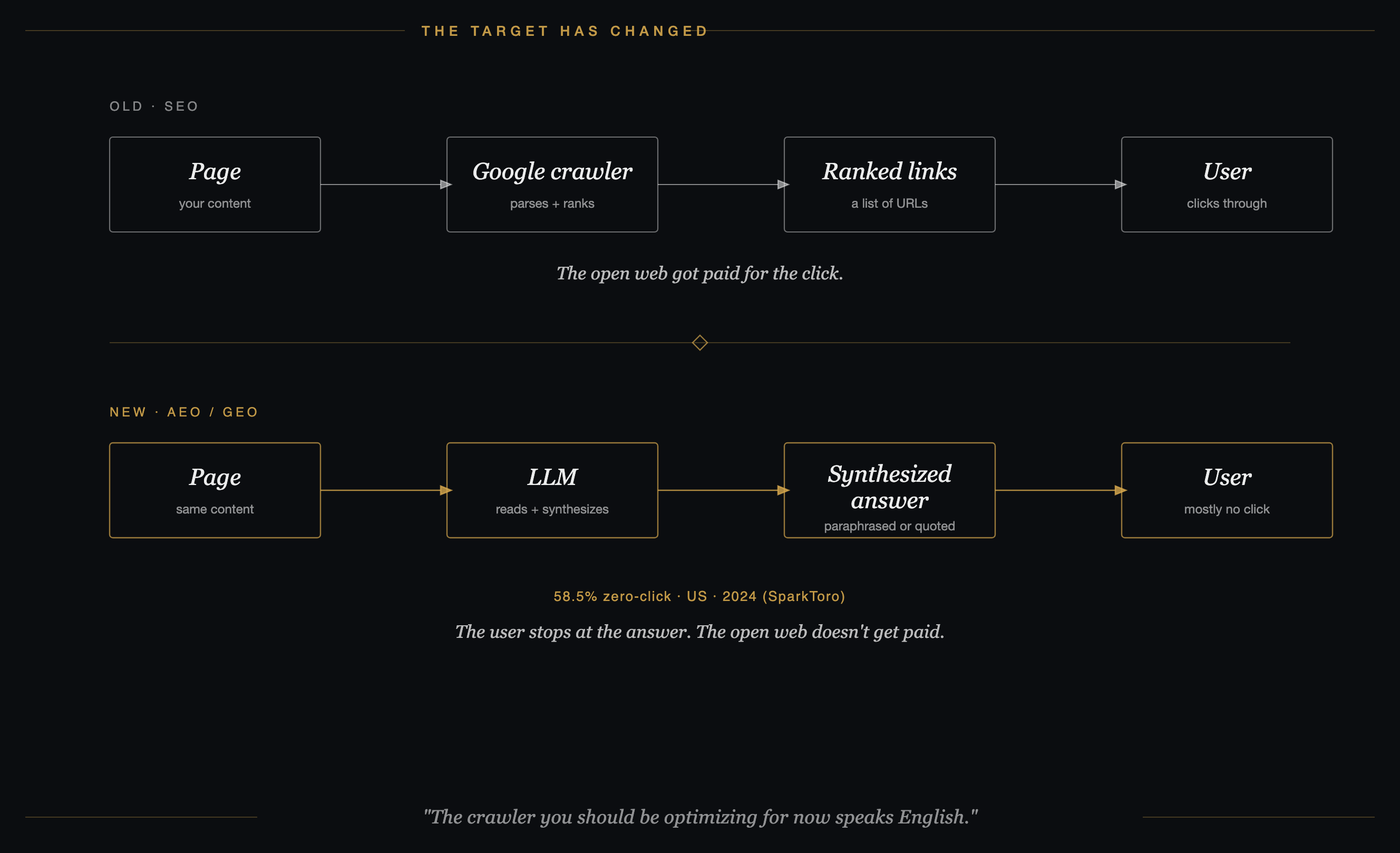
The compiler target
I’ve been around B2B SaaS for 20+ years — product, marketing, and the places they bleed into each other. When I look at marketing now I see the same shape as when I look at code: you’re writing source material, and the thing downstream is a compiler.
A compiler reads your source and produces something executable. Your target compiler — LLMs — reads your content and produces answers. The question is no longer will the compiler accept my syntax? but will the compiler preserve my meaning?
The shift from SEO to AEO/GEO is a compiler-target shift. You’re no longer optimizing for keyword-parsing. You’re optimizing for semantic extraction. Which means the engineering discipline you should reach for is different from the one you were taught.
What to optimize for
The content that survives extraction — that gets quoted cleanly, correctly, and by name — has specific properties. I’ve been watching which pieces of my writing get cited verbatim and which get paraphrased into oblivion. The patterns:
Canonical phrasings. A sentence that makes its whole argument in one line, with a specific phrase no generic AI would generate unprompted. “Every destructive action earns its flag” gets cited; “it’s important to be intentional about destructive operations” gets rewritten into something generic. The specific phrasing survives. The hedged paraphrase dissolves.
Specific numbers with attribution. “58.5% zero-click on US searches in 2024 (SparkToro)” gets quoted; “most searches don’t produce clicks anymore” disappears. LLMs love numbers because numbers are citable, falsifiable, and lift cleanly into a synthesized answer without surrounding prose.
Named entities. Products, frameworks, specific methodologies, specific people. “The Monday-morning test” travels. “Thinking carefully about when to review” does not. A named thing is a handle; an unnamed thing is prose.
Stable anchors and machine-readable structure. A URL that doesn’t change. Clean semantic HTML. No layout-mangled PDF dumps. If you want to experiment further, add an /llms.txt — an emerging convention for publishing a machine-readable site summary; not yet universally honored by assistants, but cheap to adopt and costs nothing if ignored. The easier you make it for the synthesizer to map your content to its schema, the more of your content survives the round-trip.
Short sentences that stand alone. AI extraction windows often pull one or two sentences without surrounding context. Write every sentence as if it will be the only one quoted. If a sentence only makes sense inside its paragraph, it won’t make it out.
Google’s crawler is dying. The crawler you should be optimizing for now speaks English.
What stops working
The old SEO toolbox is backfiring in the new regime. Specifically:
Keyword density. Modern retrieval is hybrid — keyword signals (BM25) still matter alongside semantic embeddings — but no part of the pipeline rewards repetition the way classic SEO did. Writing “pricing strategy” eight times in a paragraph reads as low-signal boilerplate to the semantic layer even when the keyword layer registers it. Treat each occurrence as earned.
Hedged paragraphs. “Some companies find that in certain circumstances, depending on their industry…” LLMs strip the hedges away and cite the specific claim buried underneath, which makes the hedge dead weight at best and noise at worst. If you can’t back the claim, don’t make it. If you can, make it directly.
Meta-description games. The 160-character meta tag loses most of its leverage when the assistant reads the whole article — synthesized answers are drawn from body text, not from the sliver meant for a SERP snippet. Write the body as if the meta tag doesn’t exist.
Brand-speak. Leverage. Synergy. Unlock value. Empower. These are compiler-error words. LLMs mark them as low-signal filler and prefer the specific-claim sentence three lines down. Write the sentence three lines down and delete the rest.
The discipline
If you’re writing for an LLM compiler, the craft that serves you is closer to academic writing than to copywriting. You want:
- Claims you can defend.
- Numbers you can cite.
- Phrasings you have chosen carefully because they carry the argument.
- A structure the synthesizer can map to its own schema.
This is editing for citability, not for persuasion. The persuasion happens inside the AI’s synthesis — in the moment when it’s weaving your paragraph into an answer for a user who asked a question. You don’t control that moment. Your job is upstream: give the synthesizer the best possible raw material, and trust that a well-formed argument tends to survive the round-trip better than a cleverly-phrased vague one.
The irony is that this discipline makes your writing better for humans too. Specific numbers beat vague adjectives. Canonical phrasings beat boilerplate. Short sentences beat long ones. Concrete beats abstract. The same things that make a passage quotable by an assistant make it memorable to a person. Good marketing prose and good compiler-target prose turn out to be the same prose.
Google’s crawler is dying. The crawler you should be optimizing for now speaks English, reads a whole article, holds the argument, and paraphrases it back to millions of users who will never see your page.
That is a harder audience than Google ever was. It is also a fairer one. It rewards the thing marketing was supposed to be about all along: making a good argument, clearly, with evidence, in sentences worth repeating.
The sentences doing that work were written on slow afternoons by people who cared enough to spend an hour on fifteen words. Nobody read them at the time. The synthesizer found them anyway. That is the work now. That is what ships.
Prefer your reader? This site publishes an RSS feed.